Introduction
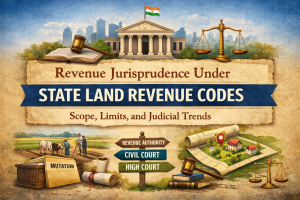
Land revenue laws form the backbone of property administration in India. While property rights are substantively governed by civil law, State Land Revenue Codes regulate the recording, collection, and administration of land-related information for fiscal purposes. Over time, courts have developed a consistent body of revenue jurisprudence, clarifying the scope and limits of powers exercised by revenue authorities under these codes.
This blog examines the nature of revenue proceedings, the jurisdiction of revenue authorities, and key judicial principles governing State Land Revenue Codes across India.
Constitutional and Legislative Framework
Land is a subject under Entry 18 of the State List (List II) of the Seventh Schedule of the Constitution. Accordingly, each State has enacted its own Land Revenue Code, such as:
-
Madhya Pradesh Land Revenue Code, 1959
-
Gujarat Land Revenue Code, 1879
-
Maharashtra Land Revenue Code, 1966
-
Rajasthan Land Revenue Act, 1956
Despite structural variations, these statutes share common objectives:
-
Maintenance of land records
-
Assessment and collection of land revenue
-
Regulation of mutation and possession entries
-
Administrative supervision over land use
Nature of Revenue Proceedings
A foundational principle of revenue jurisprudence is that revenue proceedings are summary and fiscal in nature.
Courts have consistently held that:
-
Revenue authorities do not decide title
-
Revenue entries do not confer ownership
-
Mutation is meant to ensure smooth revenue collection, not adjudicate civil disputes
The Supreme Court has repeatedly clarified that mutation entries neither create nor extinguish rights, and disputes relating to ownership must be resolved by civil courts.
Jurisdiction of Revenue Authorities
1. Mutation Proceedings
Revenue authorities such as Tehsildars or Mamlatdars are empowered to:
-
Record changes in landholding due to sale, gift, will, inheritance, or partition
-
Issue public notices and hear objections
-
Pass mutation orders subject to civil court outcomes
However, they cannot:
-
Decide the validity of title documents conclusively
-
Adjudicate disputes involving fraud, forgery, or competing ownership claims
2. Possession and Revenue Entries
Revenue records may reflect possession, but courts have cautioned that:
-
Possession entries are not proof of legal possession
-
Revenue entries have presumptive value, not conclusive value
Claims such as adverse possession, agreement to sell, or ownership disputes fall outside revenue jurisdiction.
Revenue Authorities vs Civil Courts
One of the most litigated aspects of revenue jurisprudence is the overlap between revenue and civil proceedings.
Judicial consensus holds that:
-
Revenue proceedings can continue despite pending civil suits
-
Revenue orders must be made subject to civil court decisions
-
Civil court decrees override revenue entries
Revenue authorities are bound to give effect to civil court judgments, but cannot pre-emptively decide issues pending before civil courts.
Supervisory Jurisdiction of High Courts
High Courts frequently exercise powers under Articles 226 and 227 in revenue matters. However, courts have imposed self-restraint, holding that:
-
Supervisory jurisdiction is limited to correcting jurisdictional errors
-
High Courts should not re-appreciate evidence like appellate courts
-
Concurrent findings of revenue authorities should not be disturbed lightly
Interference is justified only where:
-
Principles of natural justice are violated
-
Orders are perverse or without jurisdiction
-
Statutory provisions are ignored
Revenue Codes and Natural Justice
Revenue jurisprudence has strongly reinforced procedural safeguards, including:
-
Issuance of public notice
-
Opportunity of hearing to affected parties
-
Reasoned orders
Mechanical or non-speaking orders passed by revenue authorities are routinely set aside by courts.
Digitalisation and Emerging Issues
With digitisation of land records and introduction of e-mutation systems, new challenges have emerged:
-
Incorrect online entries
-
Lack of human oversight
-
Difficulty in rectification of errors
Courts have clarified that digital records carry the same legal limitations as physical records and do not override substantive rights.
Judicial Trend: Consistency Across States
Although State Revenue Codes differ, courts have evolved uniform principles, including:
-
Mutation is fiscal, not title-conferring
-
Revenue authorities are not courts of plenary jurisdiction
-
Civil courts remain the final arbiters of title
-
Revenue law must serve administration, not supplant civil adjudication
This consistency strengthens predictability and limits misuse of revenue proceedings for settling civil disputes.
Conclusion
Revenue jurisprudence under State Land Revenue Codes reflects a careful balance between administrative efficiency and protection of property rights. While revenue authorities play a crucial role in land administration, judicial pronouncements have firmly demarcated their limits.
Understanding this jurisprudence is essential for litigants, lawyers, and administrators alike, as misuse or misunderstanding of revenue law often leads to prolonged and unnecessary litigation.