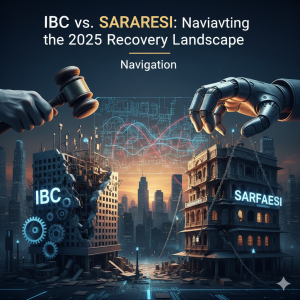
For any lending institution, the ability to recover dues is as vital as the ability to lend. In India, two giants stand at the center of this process: the SARFAESI Act (2002) and the Insolvency and Bankruptcy Code (IBC, 2016). While both aim to tackle Non-Performing Assets (NPAs), their philosophies are worlds apart.
As we move through 2025, new amendments have blurred the lines and shifted the power dynamics. Here is everything you need to know about the current state of recovery and insolvency.
1. SARFAESI: The “Direct Action” Weapon
The SARFAESI Act remains the fastest way for banks to recover secured debts without the headache of court intervention.
-
How it Works: Once an account is classified as an NPA and remains unpaid for 60 days after a notice (Section 13), the bank can simply seize and auction the collateral.
-
2025 Update: The threshold for NBFCs to use SARFAESI has been lowered. Now, eligible NBFCs can initiate recovery for debts as low as ₹20 lakh (down from ₹50 lakh), making it a powerful tool for retail and SME lenders.
-
The Limitation: It only works for secured creditors and cannot be used for agricultural land or loans where 80% of the principal has already been repaid.
2. IBC: The “Resolution First” Framework
Unlike SARFAESI, which is about “taking the house,” IBC is about “fixing the business.” It seeks to revive the company as a going concern.
-
The 2025 Overhaul: The IBC (Amendment) Bill, 2025 introduced the Creditor-Initiated Insolvency Resolution Process (CIIRP).
-
Out-of-Court Speed: Creditors with 51% voting share can now initiate insolvency largely out-of-court, avoiding the multi-year delays previously seen at the NCLT.
-
Management Stays (Mostly): Unlike the traditional CIRP where the board is suspended immediately, the 2025 CIIRP follows a “hybrid” model where existing management stays but under strict supervision of a Resolution Professional (RP).
3. The Great Conflict: Who Wins?
When a bank starts a SARFAESI auction, but another creditor files for IBC, who takes priority?
-
The Moratorium Shield: The moment an IBC application is admitted, a Moratorium (Section 14) kicks in. This acts as a “Pause Button” that freezes all SARFAESI auctions and legal suits.
-
Supreme Court 2025 Ruling: In National Spot Exchange Ltd. v. Union of India (2025), the SC clarified that while IBC generally overrides SARFAESI, attachments made under criminal laws (like PMLA) may still take precedence.
-
The Waterfall Mechanism: If the company goes into liquidation, the Waterfall Mechanism (Section 53) dictates the order of payment.
-
Priority 1: Insolvency process costs.
-
Priority 2: Secured creditors and 24 months of workmen’s dues.
-
Priority 3: Unsecured financial creditors.
-
Priority 4: Government dues (Note: 2025 amendments clarified that Govt. dues are not secured debts).
-
4. IBC vs. SARFAESI: At a Glance
| Feature | SARFAESI Act | IBC 2025 (CIIRP/CIRP) |
| Primary Goal | Asset Recovery/Sale | Business Resolution/Revival |
| Court Intervention | Minimal (No court needed for seizure) | High (NCLT supervision) |
| Applicability | Only Secured Creditors | All Creditors (Financial & Operational) |
| Moratorium | None | Automatic (on admission) |
| Impact on Management | Borrower loses asset | Management is replaced or supervised |
5. Summary for Professionals
If you are looking for speed and have clear collateral, SARFAESI is your best bet. However, if the borrower is a complex entity with multiple creditors and a viable business, the 2025 Creditor-Led IBC (CIIRP) offers a more structured way to maximize value without destroying the company.